Friday Sep 18, 2026
Friday Sep 18, 2026
Friday, 18 September 2026 00:28 - - {{hitsCtrl.values.hits}}
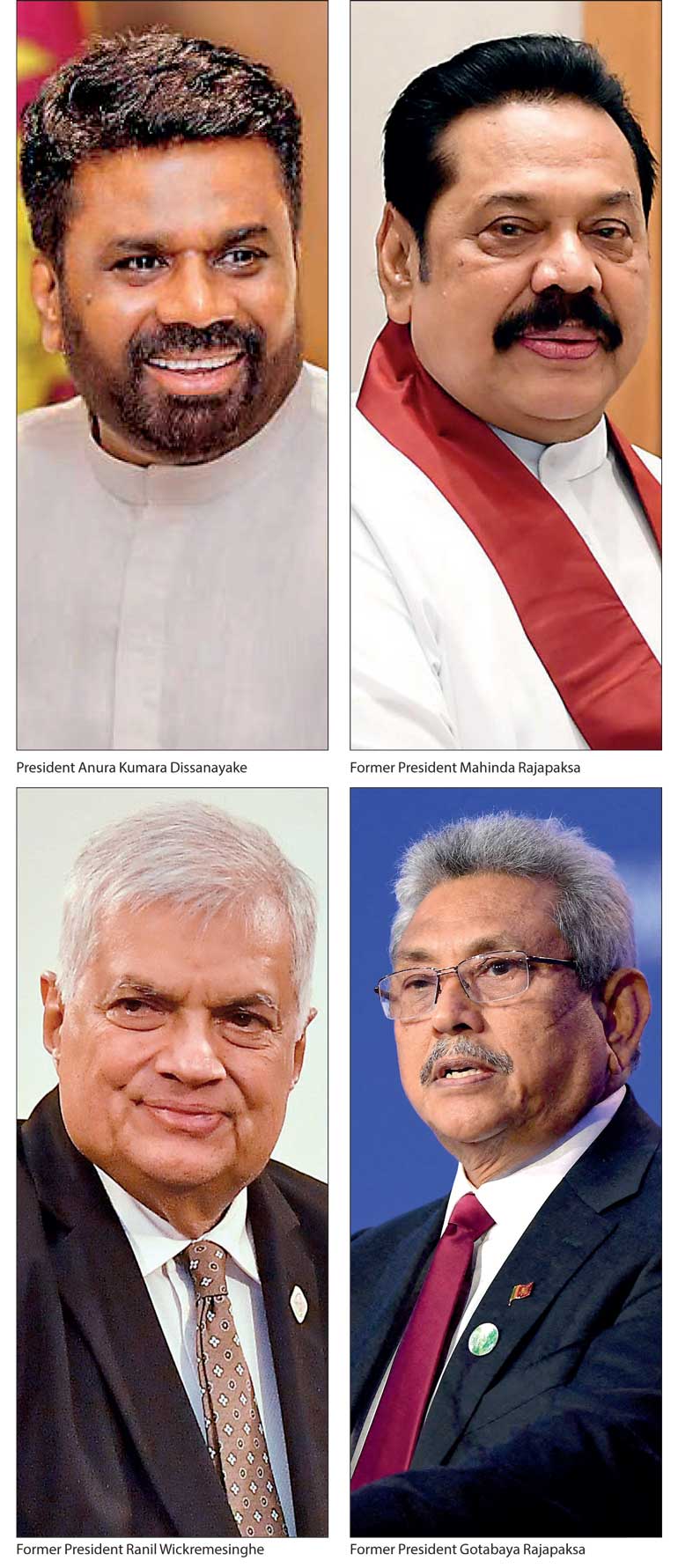
 "Ape Aanduwa; Wasara Dekayi, Ratata Subai" is the strategic narrative advanced by President AKD and the National People’s Power (NPP) Government to mark their two-year milestone in office.
The ruling dispensation formally translates it as "Our Government: Two Years - Good for the Country".
The word "Subha" (සුභ) in Sinhala literally means "auspicious,". It is not just plain good. It is promisingly good. In English it conveys something such as “boding well”. It portends a bright future.
NPP rebranding
While "Ratata Subai" is simplified as "Good for the country" in everyday parlance, ‘auspicious’ delivers a nuanced message - optimistic and forward-looking.
It is my intuitive guess that the crafting of this slogan with its nuanced optimism and long-haul focus is the work of JVP’s veteran ideologues and carries the imprimatur of Comrade Tilvin.
The NPP just didn’t win the parliamentary elections. They were swept into office after AKD’s razor edge performance in the presidential election. Sri Lanka’s voters surprised themselves.
At that point in history, when Aragalaya gathered its own momentum, the NPP relied on the demand for ‘System change’ in silent solidarity with the Aragalaya movement. So, they ingeniously offered the captivating theme “Let the Real People Win.”
Two years in the business of governance, the new slogan of ‘Ratata Subhai’ marks a new phase of rebranding. It moves away from the rhetoric of anti-establishment Opposition. Now it is focused on a legacy of stable governance.
That said, a rational analysis of their two-year track record cannot escape their overriding dilemma.
They walk a tightrope between the JVP’s foundational Marxist-Leninist ideology and its modern, governance-focused rhetoric of cozy comforting relations with the many and varied chambers of commerce and industry.
NPP’s economic policy, if there is one such, is in aimless drift. Its policy ambiguity captures the central paradox of the NPP Government’s approach to the economy.
Like Lewis Carroll’s Alice trying to pin down a vanishing Cheshire Cat with its smile, observers and investors analysing Sri Lanka’s economic landscape find that the closer they look, the more the policy specifics end up in broad, reassuring smiles of President AKD.
To be blunt, AKD has come to terms with Ranil W’s orthodox reality. Once in power under President AKD, the cheshire cat has turned into a protean creature.
AKD has emphatically maintained ‘macroeconomic continuity’ with Ranil’s fiscal program. They have consistently met IMF review targets, preserved the core of the Economic Transformation Act, and retained major revenue consolidation measures.
AKD and the NPP Government are heavily dependent on governance reform as its central policy platform.
Their rhetoric heavily emphasises anti-corruption, systemic overhaul, and democratic accountability. That offers ample space to opponents both on the right and left. They gleefully point to the historical, more rigid ideological framework of the party of Rohana Wijeweera.
This is strategic political ambiguity. NPP supporters claim that it is a process of necessary evolution to address contemporary economic realities dictated by a diverse electorate.
There is a class war
There is a ‘Class War’ that is raging under the thin ice of reassuring economic indicators released by the Treasury and the Central Bank. The opposition to the 22nd Amendment is classic class war in disguise.
This is how it all began
The sight of Ranil Wickremesinghe, a former Sri Lankan President escorted into a prison bus on 22 August 2025, marked a historic semiotic turning point.
It was a piece of quasi-street theatre, choreographed or otherwise by the new political order to signal the end of an elite class and a decisive collapse of political impunity in Sri Lanka.
For Ranil, a man, manor born and steeped in power and privilege, lunching with Swaraj Paul in Wolverhampton was an ordinary and harmlessly simple affair—made even simpler by a touch of presidential discretion that took from Peter to pay Paul. The law is yet to determine how simple or complex that encounter was.
For the first time in modern Sri Lankan history, a former executive president experienced physical detention and prison transport.
It was a distinctive message of the leveling of power. Wickremesinghe—a veteran five-decade political operator who outmaneuvered rivals—was visually reframed inside a standard prison vehicle, equalised under the law with ordinary detainees.
The imagery signaled a potent message to the public about the new administration’s anti-corruption drive, transforming a legal proceeding into a powerful public theater of accountability.
To supporters of the ruling party as well as many neutral middle-class people with no inherited wealth the Prison Van represented long-delayed justice.
To RW’s supporters gathered outside the courthouse, it was perceived as a harsh, politically motivated humiliation of a national leader.
With the heir apparent of the Rajapakse family that brokered massive economically unviable infrastructure investment, in remand custody the SLPP has responded with a show of strength in Anuradhapura.
SLPP’s Anuradhapura shindig
The SLPP’s Anuradhapura display of its organisational capacity and its ability to enlist a disparate list of political wanderers under its ample shade holds a lesson. It strikes at the heart of contemporary Sri Lankan politics.
It pits the NPP’s transformative revolutionary intent against deeply entrenched structural traps of repeated history.
NPP and AKD may view the downfall of the old elite as a permanent rupture in history. But as Marx pointed out on his brilliant analysis of the French revolution, failure to make deep structural changes, the old regime might simply reappear in a new, farcical disguise.
Marx’s celebrated essay ‘Eighteenth Brumaire of Louis Napoleon ‘is famously known among students of Marx who aren’t necessarily ‘Marxists’ for the adage that history repeats itself, “the first time as tragedy, the second time as farce.”
Learning from Marx 
Marx analyses how the French Revolution of 1848, which sought to overthrow a corrupt monarchy, inadvertently created a power vacuum filled by Louis Bonaparte—a mediocre adventurer who weaponised populism to establish a dictatorial regime.
NPP’s presumed clean break with the past may turn out to be illusory. Marx warned that revolutionaries often believe they are creating something entirely new, yet they remain haunted by the past!
“The tradition of all dead generations weighs like a nightmare on the brains of the living.”
The NPP has installed its own team in power. But it has inherited the same bankrupt state apparatus, debt structures, and bureaucratic inertia left by the ‘ancien régime.’
If the NPP merely replaces elite figures without changing the underlying economic architecture, the ghosts of the old system will inevitably re-emerge.
There are several candidates for the role of Louis Napoleon in our ‘milieu’.
Louis Bonaparte succeeded because he positioned himself above the class struggle, presenting himself as a savior to a fractured society.
If the NPP focuses too heavily on the spectacle of punishing the old guard rather than resolving the material grievances of the poor, the hungry and the wage-earning classes, they risk slipping into a form of “Bonapartism.” 
True systemic change requires dismantling the socioeconomic conditions that allowed the old elite to thrive, not just staging moral victories.
If a reformist movement fails to deliver on its revolutionary promises due to systemic constraints, it creates public disillusionment.
In the aftermath of the French revolution that beheaded a monarch, popular disillusionment allowed a farcical imitation of Napoleon to seize absolute power.
The warning to the NPP is clear: if they fail to manage the current historical moment with ideological rigour, they open the door for a populist, right-wing backlash that could be even more destabilising than the original ancien régime.
The NPP’s political project relies heavily on a classic Marxist leaning social-democratic assumption: that enlightened material self-interest will lead the working and peasant classes to reject corrupt oligarchs.
The Lumpen Class
However, the Anuradhapura Rally exposes the limit of this assumption.
The lumpenproletariat is often deeply conservative and skeptical of systemic, structural overhauls.
To a class accustomed to navigating survival through clientelism, the NPP’s promise of “system change” and meritocracy feels abstract, distant, and cold. They prefer the flawed certainty of a known patron over the revolutionary uncertainties of a reformed state
The SLPP’s Anuradhapura rally provides contemporary proof of Marx’s assertions in the Eighteenth Brumaire regarding the stubborn loyalty of the lumpenproletariat.
While the organised middle classes and class-conscious proletariat demand systemic legal accountability for the old regime, the marginalised underclass views the prosecution of Namal Rajapaksa through the lens of disrupted patronage.
For this group, anchored in informal economies and bound to the state via clientelism, the fall of the Rajapaksa dynasty represents a terrifying vacuum. By rallying around Mahinda Rajapaksa in the ancient capital, they demonstrate how easily a ruling class can weaponise cultural hegemony to turn the most economically exploited layers of society into the fiercest defenders of their exploiters.
A word of advice to President AKD
You and your party, the NPP, have chosen the capitalist path. Very Good. But you must also pay a little attention to Karl Marx. I will tell you why.
Transformative movements should study Karl Marx not as a dogmatic blueprint, but as a dynamic method for understanding power, organising collective action, and sustaining systemic change.
Political experiments carried out in Karl Marx’s name have historically varied and sparked deep ethical debates. But Marx’s foundational texts offer modern activists’ indispensable tools to diagnose structural problems and move beyond surface-level reforms.
In simpler terms, proof of the pudding is in the eating. What matters finally is not how many are in jail. What matters is how many homes are subsisting on just one meal a day.
As Amartya Sen said “Human life does not stand or fall on the success of the market, nor on the growth of the gross national product. It depends on the freedoms we have and the lives we can lead.”